A forum for discussing woodworking, specifically furniture making. Feel free to post comments and questions about your current projects, tools, studio set-up, or whatever is on your mind. This blog is moderated by Jamie Yocono, owner of Wood It Is! Custom Cabinetry in Las Vegas, NV. Her website is wooditis.com. If you need to speak to an actual human... call 702-672-8981! Now...let's talk wood!
Sunday, March 31, 2024
Clay times!
Tuesday, March 05, 2024
SawStop to release patented technology to public
TUALATIN, Ore. — SawStop, manufacturers of one of the wood industry’s most widely used safety technologies, announced that one of its key patents will, in the future, be made open to the public.
The action, announced on Feb. 28, was taken in response to a proposed rule by the Consumer Product Safety Commission that would require all table saws sold in the U.S. to have active injury mitigation (AIM) technology to make them significantly safer.
In a Feb. 29 press conference, Matt Howard, CEO of SawStop said that the company has committed to dedicate its U.S. Patent 9,724,840 to the public upon the rule’s effective date. The rule is meant to prevent the thousands of amputations and hospitalizations that can occur during the cutting process without industry-wide action.
“We work to protect and inspire all woodworkers, from novice hobbyists to professional craftspeople. Opponents of the proposed rulemaking have identified this patent as their key obstacle to offering safer saws,” said Howard. “We invest heavily in safety innovation, and our patents have real value. Even so, we will not allow this patent to be an obstacle to a safer future. To that end, SawStop is prepared to dedicate this ‘840 patent to the public upon the effective date of a rule requiring active injury mitigation technology on all table saws. Although such a rule is likely many years away from an effective date, we at SawStop are determined to seek a win-win balance between our mission and our business responsibilities.”
According to the company's website, the SawStop works in four broad steps: detect, stop, drop, and reset.
The SawStop detects a small electrical signal that the blade carries. When skin contacts the blade, the signal changes because the human body is conductive. The hange to the signal activates the safety system.
An aluminum brake springs into the path of the blade. The blade comes to a complete stop and power to the motor is shut off. After the blade comes to a stop, the blade’s angular momentum drives it beneath the table, removing the risk of subsequent contact. All of this happens in less than 5 milliseconds.
Resetting the saw is easy, according to the website. Simply inspect the blade (and change if damaged) and replace the brake cartridge, and the saw is operational. The entire process takes 90 seconds and the user is back to work, according to the company.
Safety standards
On Nov. 1, 2023, the CPSC published a supplemental notice of proposed rulemaking under the Consumer Product Safety Act proposing to issue a safety standard addressing blade-contact injuries on table saws. The proposed rule would require all table saws to “limit the depth of cut to no more than 3.5 mm” when a test probe, acting as a surrogate for a human finger or other body part, contact the spinning blade at a rate of 1 meter per second.
As the pioneer in safety technology for table saws, SawStop believes such a standard will radically improve the overall safety of all table saws sold in the United States. It will help prevent the tens of thousands of severe injuries annually that result in billions of dollars in corresponding healthcare, pain, and suffering costs for victims and society, the company said in a statement.
In the past, SawStop has vigorously defended its patents. Bosch was prevented from selling its REAXX saws in the United States after SawStop filed objections with the International Trade Commission. The Bosch saw used similar contact- sensing technology to SawStop, but used a gas cartridge system similar to an automotive airbag to move the blade out of the way.
More recently, major European manufacturers such as Altendorf and Felder have developed proximity sensing technology that does not rely on any blade contact to stop the blade before an injury can occur. Those systems also have the advantage of not damaging the saw blade when triggered or having to replace a cartridge or triggering mechanism, thus allowing for instant reset.
The SawStop company was purchased by TTS Tooltechnic Systems, which also owns Festool, in 2017.
William Sampson contributed to this report.
Here's another article that was just released in WoodShop News:
SawStop announced it will dedicate its patent to the public if a proposed rule regarding table saw safety becomes effective.
“Today, in response to proposed rulemaking regarding table saw safety by the U.S. Consumer Product Safety Commission, SawStop committed to dedicate U.S. Patent 9,724,840 to the public upon the rule’s effective date,” the saw manufacturer said in a Feb. 28 post. “The intent of the proposed rule is to prevent the thousands of amputations and hospitalizations that will continue to occur without industry-wide action.”
“We work to protect and inspire all woodworkers, from novice hobbyists to professional craftspeople. Opponents of the proposed rulemaking have identified this patent as their key obstacle to offering safer saws,” said Matt Howard, CEO of SawStop. “We invest heavily in safety innovation, and our patents have real value. Even so, we will not allow this patent to be an obstacle to a safer future. To that end, SawStop is prepared to dedicate this ‘840 patent to the public upon the effective date of a rule requiring active injury mitigation technology on all table saws. Although such a rule is likely many years away from an effective date, we at SawStop are determined to seek a win-win balance between our mission and our business responsibilities.”
Which side are you on?
There is a ton of arguing and animosity toward SawStop - but I'm a firm believer that their saws keep people very safe. I'm a fan - their tools are accurate and quality. Even if the saw didn't have this technology installed in it, I would still purchase one.
Just....
Tuesday, February 27, 2024
Sending the beast on its way!
It's been a minute, right?
I finally finished this massive coffee table renewal - from attaching the legs, to retrofitting the skirting, to trimming out the top with metal. And more!
This beast has been in my shop for a month. The owners (and I) couldn't decide on a proper patina for the metal trim on the corners and the top. Matte black? Rusted rustic?
We tried a variety of colors and chemical patinas, but in the end - they took it without a finish on the metal. They'll experiment on it until they come up with something that they can live with.
Wednesday, February 07, 2024
Leveling up the table
Wednesday, January 31, 2024
Upright and ready to bolt!
Friday, January 26, 2024
A beast of a project
It started when a customer brought this piece to my shop, asking me to turn it into a coffee table.
I'm not even sure what to call this – from this view, which is the bottom of it, it looks like an old farmhouse door. Maybe something from a cellar, with numerous coats of paint, and some odd handwriting on the panels. The wood surrounding the doors is massive and heavy, and mostly rotted.
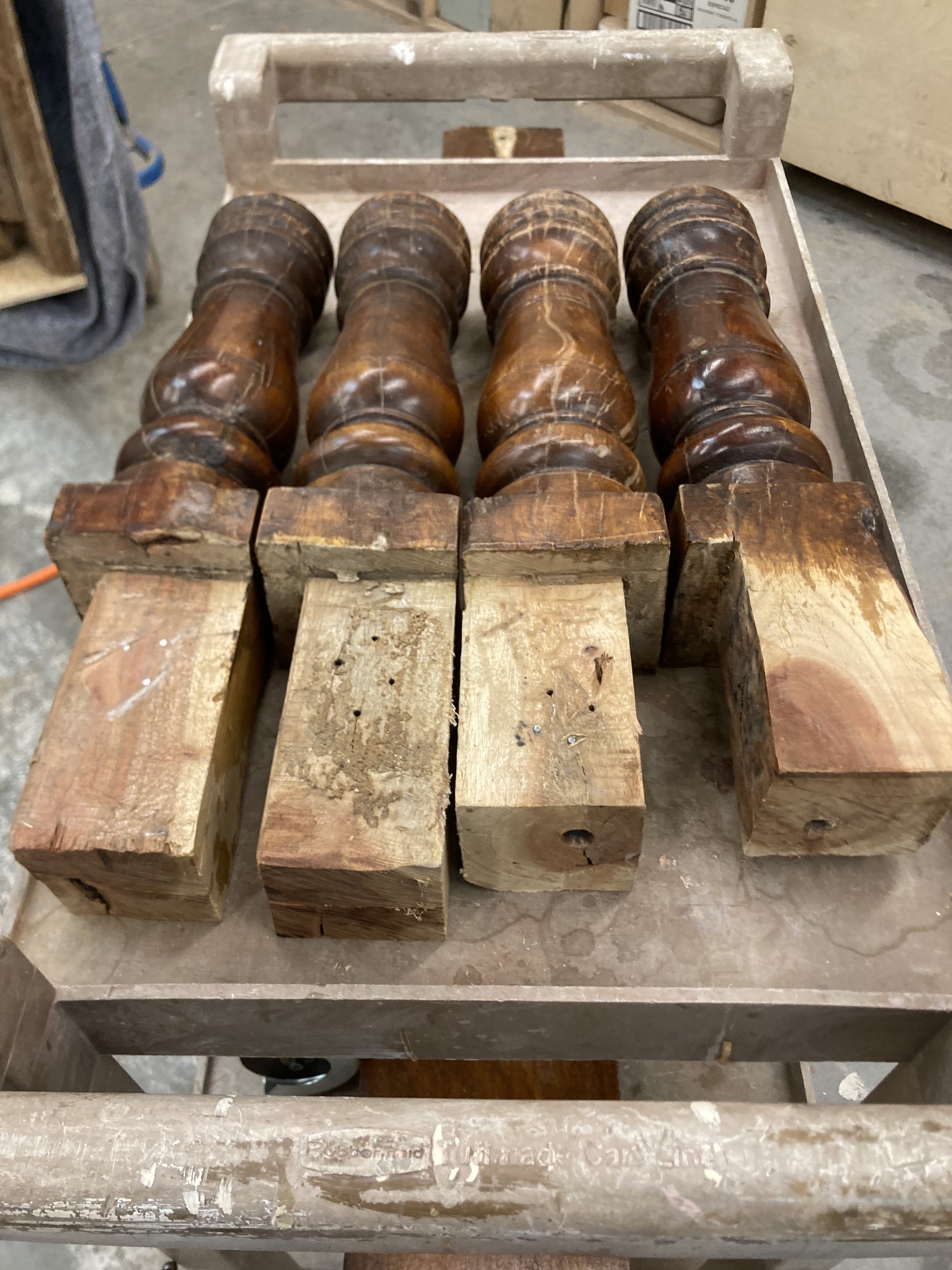
They also gave me a set of legs, and upon further inspection, these legs appear to be made from solid blocks of wood. I can't identify the species, but I know the wood is heavy.
Really heavy.
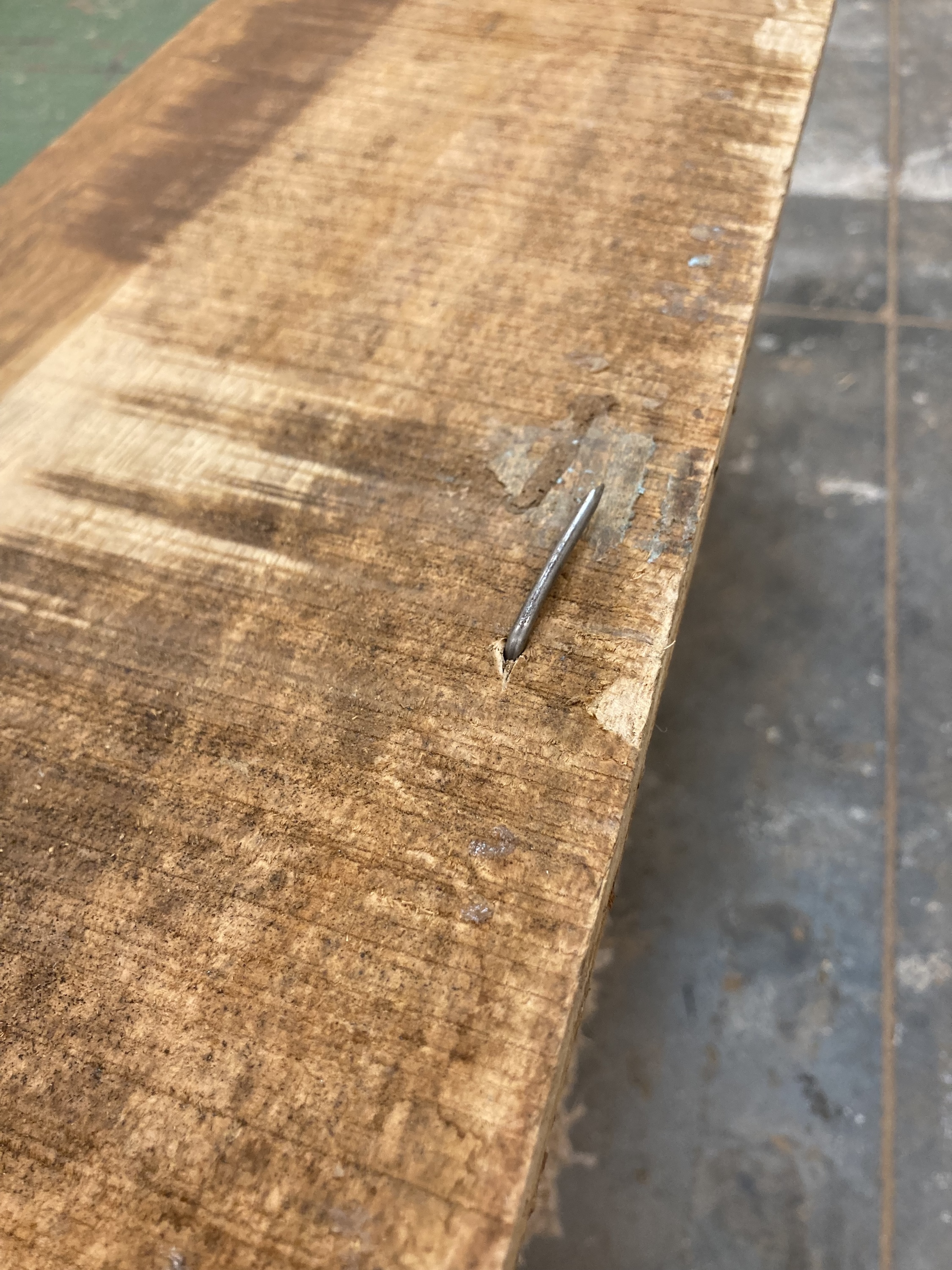
The skirting around this piece was in horrible shape, with old hardware attached to it, and dozens of nails in it.
Most of them were bent over, and I pulled out this cut off wheel
to get rid of the nails.
Did I mention some large cracks in the skirting?
Luckily, I had a syringe that made it easy to get glue in all of the cracks. After clamping all of the repairs, the cracks mostly disappeared.
The corner of one of the skirting boards that was missing. These boards have such a nice patina and distressing to them, that I decided to repair this corner. So I trimmed off the ragged edge,
and dug out a piece of wood to match it.
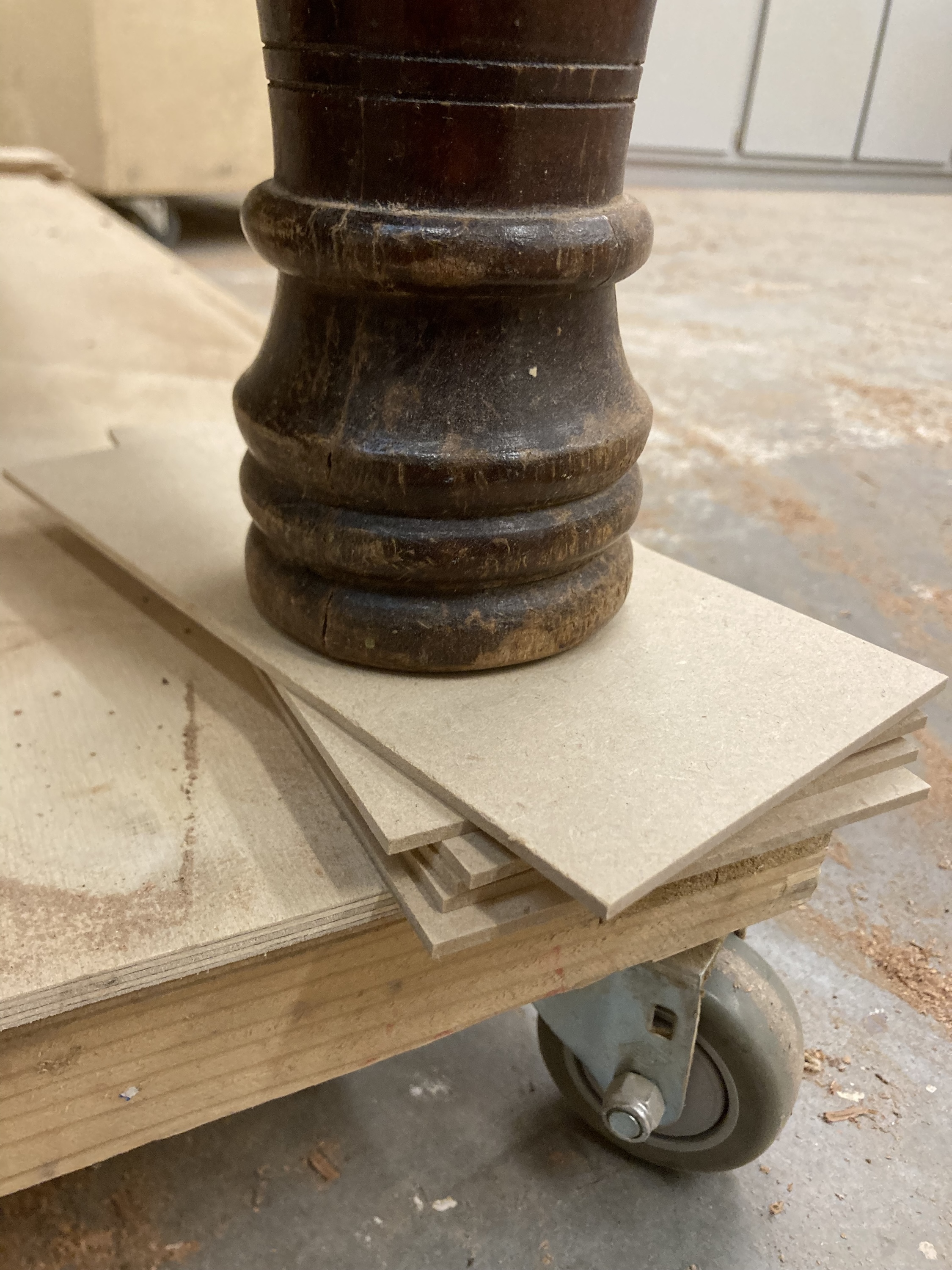
When I turned my attention to the legs, I realized that the top part of each leg was out of square, and at different lengths. I have no idea how they made those legs work for this piece, but maybe these legs were from another project.
One by one, I attached each leg to the corners, attaching them in place with perpendicular bolts. Drilling through the top of these legs felt like drilling through concrete.
Wednesday, January 10, 2024
Not-so-much Fun with Angles

Friday, January 05, 2024
Fun with angles
It's that time of the year - time for cleaning, finishing up some projects, and planning for what needs to be built going forward.
After finishing that huge Sapele linen cabinet that frankly, was a little overwhelming,
I wound up with a stack of cut-offs from the lumber I was using. (Thanks for the major help with that, Ken!) They weren't long - maybe ten inches or so, and it was either - use them, give them away, or burn them.
I love this calculator for building with segments. It lets me design a frame like this, tweaking it until I have the specifications that I want.
I started with 16 pieces, about 10" long and 3" wide. Of course I Domino'ed them!
It starts with gluing together two pieces.
And then gluing that set into a 4-piece set. And so on...
When you start getting larger segments, the clamping can be a little tricky. In this case - a clamp is needed end-to-end, but the force of that makes the miter want to come apart, so a perpendicular clamp is needed. Also - an extra set of hands is nice to have.
These two "quarter segments" now get glued into a half. And so on... until I had two halves.
Here's the best part - once you have two halves, you can check the joints on the two halves, to see if they mate correctly. If not - you can correct the angles slightly, to make you look like a woodworking rockstar. That sketch below shows that the two haves are slightly off, but easily corrected.
Clamping that was a little tricky - the strap clamp needed to put this together has to be HOW LONG??
Well - if that circle has a four-foot diameter, what's the circumference? Well, I guess it's a good thing math is my friend. So here's how you calculate it:
Circumference of a circle who’s diameter is 4 ft
C =
Let
C = 3.1416
C = 12 and 354/625 or = 12.5664 ft
Answer is: 12.5664 ft
So the bigger question is - who has a strap clamp that is 13 feet long?
NO ONE! But in a pinch, a towing strap will work, along with a couple of long bar clamps. Of course, I forgot to shoot a picture, but trust me - it worked.
And here's the final piece, assembled and ready to be cut into a circle.
I added a temporary center piece, to attach my router/compass.
It was fairly easy to find the dead center, measuring from a few different sides, to find the center point.
Wonder how my round frame turned out? Stay tuned...