Tuesday, October 16, 2012

Hopping outside the comfort zone, or ... making the log table base

With the exception of some sanding, the top of this rustic table is done. I turned my attention to building the base, but I'm getting dangerously low on wood. I have this one board left, plus one other much smaller piece. 

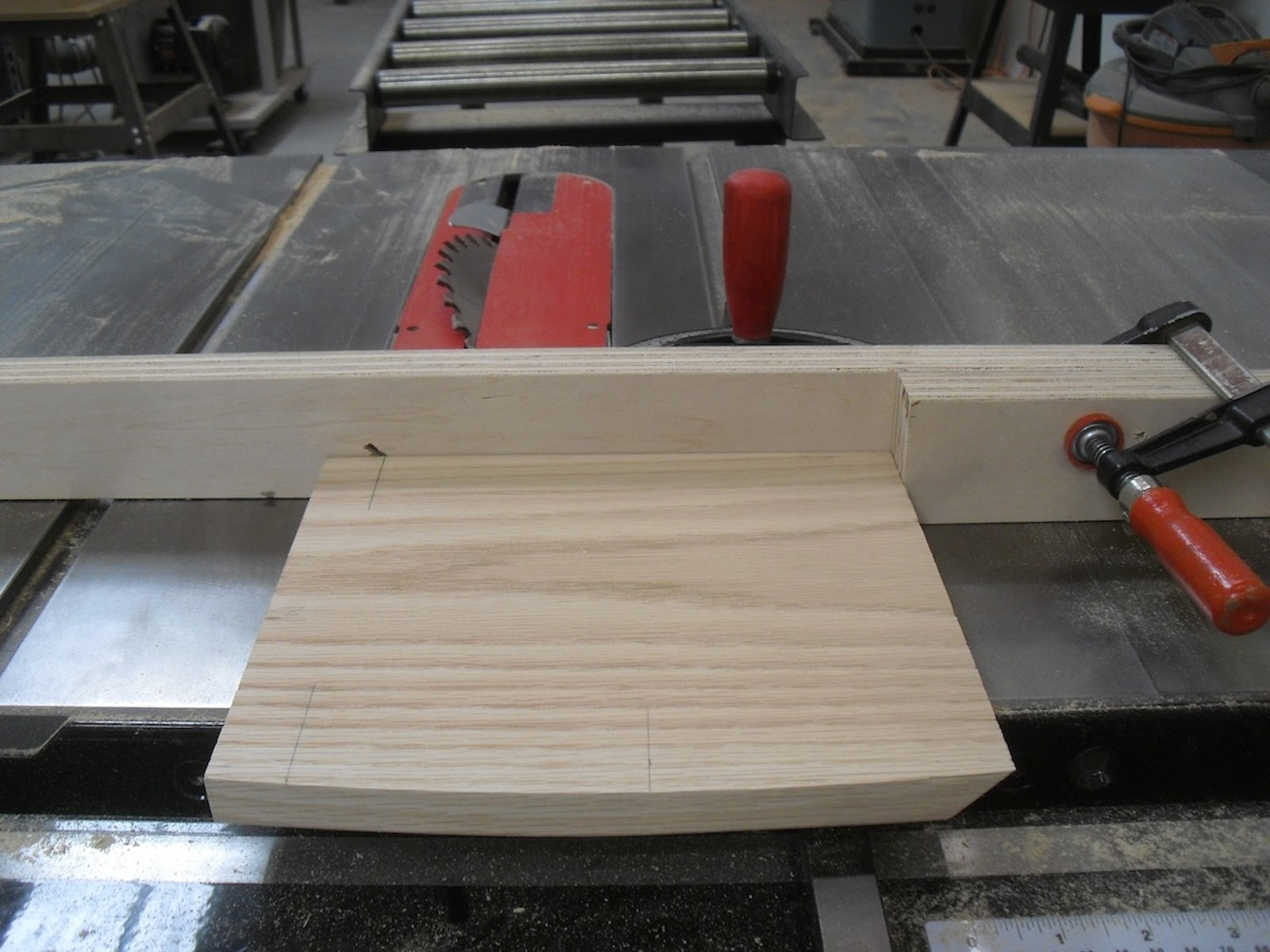
It's a little dicey cutting a board like this, especially with the live edge. With no flat surface resting against the fence, the board is liable to shift while crosscutting it. I used a few shims between the board and the fence, to keep it from rocking. 


And - since this board is wider at one end, it was a little tough to determine the cut that would make this piece sit perfectly perpendicular to the floor. A little measuring helped, I drew a straight line where I needed to cut. 


One piece is perfect, just like it is. 


It will be wide enough to support the top just fine. 


But the other piece was a little too narrow, so I pulled out the board stretcher I bought last year. It's a device I use when I need to make a board a little wider. 

Wait ... what?

Did you fall for that?

Since the board already had a crack down the center, I decided to slice the board open right there.  

I drew the line I wanted to slice along, 


and set up the Laguna. 


It sliced apart without any difficulty. 


In fact, it was awesome to watch. 

After cutting it apart, I was able to decide how wide the additional piece needed to be. 


Once all of the edges were run over the jointer, I glued this other side panel together.


I only have one piece of wood left - roughly a 2x6, which will be the center stretcher to connect the two sides. It's going to take a little creativity to attach the tabletop to the base, allowing for movement and weight, while adding strength. 

And while this style of furniture is really outside of my usual design aesthetic, I have to say that I'm really enjoying this project. The client is a joy to work with, and it's good for me to get out of my comfort zone once in a while. 

I highly recommend it!


Monday, October 15, 2012

It's time to confess...

They say it's good to confess something; we become lighter when the burden is lifted from our shoulders. So I am going to confess two things here. 

One - (people who hang out in my shop know this) - I am a big fan of rap music. Snoop? Jay Z? Eminem? You name the playa and he or she is probably on a playlist of mine.

Two - I've never eaten a Hot Pocket. I've heard they're delicious, but they just don't look that appealing to me. 


Friday, October 12, 2012

My next Amazon purchase...

Jeff Miller is one of my favorite woodworking authors - so I was thrilled when my buddy Eric sent this link to the first chapter of Jeff's new book. 


The book is Foundations of Better Woodworking, and this chapter looks terrific. 


I know the next book I'll be ordering from Amazon!

Tuesday, October 09, 2012

Butterflies are free


The cedar tabletop glued up perfectly, but there were a couple of troublesome areas. In a few areas, there was some major checking on the ends. 


Cracks - we all have them!


I'm not afraid of crack(ing.)  

One of the best ways to halt the advance of it is to put in a butterfly, or as some people call them - a dutchman. Here's a blog post showing a gorgeous one. He really doesn't go into how he made one - so I will.

I start by making one, out of plywood. This is just a piece of scrap, but I'll need it to make a template.


I tacked it to a piece of plywood, and plunge routed around it, 


thus making a pattern (or template).


I put the template over the crack, with the smallest part in the middle.


And clamped it in place.


Using one of those router inlay kits you can buy anywhere, I routed out the shape about a half inch deep. Then I used the kit to make the actual piece that fits inside - or as I like to say - Ms. Butterfly.


It is a tight fit - so don't go pounding it in before you've applied glue, or you'll never get it out! Don't ask how I know that!

 Apply some glue and pound it in place, using a block of wood to pound on. If you hammer directly on top of the butterfly, you might crack it. Cracks are what we're trying to eliminate!


Once it's dry, you can plane it flush.


I had to address the ends of the table top - the fellow who I am making this table for didn't want square ends, but rather - something organic, to mimic the live edges that still have bark on them.

So I pulled out my trusty Sawsall and cut the edge, angling it a bit so it would match the sides.


There was a nasty knot that I had to dance around.


The Sawzall doesn't mess around.


And neither does my Festool sander. I put an 80 grit disc in the sander and had my way with the ends. I just like saying that.


A little more sanding and this tabletop is finished. Now I can put my attention on making the base - which will probably require more butterflies. 

At least they're free!

(Happy Birthday, mom!)


Monday, October 08, 2012

The Olympic Torch cabinet


It's always nice to finish a piece and receive a picture from the buyer, with it placed in their home. The family that commissioned the Olympic torch display cabinet picked it up this past weekend at the shop. 


But - taking a picture of something in my office never does it justice.  They brought the torch with them, to test the fit.  

Later, when they hung the piece in their home - they sent this one. 


Then they added a couple of lights and took another shot.


There is small access door on the top of this piece, so that you can place the torch inside.

Damn, I get to build some of the coolest stuff! 


Thursday, October 04, 2012

It takes a village, again!


You know how I'm always saying "practice makes perfect" in the woodshop? Here's another case of that! A past client of mine wandered in with some of the most awesome aromatic cedar boards I've ever seen. He saw them at a lumber mill in Colorado and had to have them. (I know that feeling!)

They were roughly two and a half inches thick, and six feet long.  Really gorgeous boards, but with some splits and checking throughout.  


His vision was to make a dining table with them - so we sat and discussed a few details, but he mostly left things up to me. Sweet. The plan is for me to make this table, and since he's a painter/finisher - he's going to apply the final finish.

That's even sweeter, in my mind!

I started by running the planks over the jointer. They were bigger than me!


The top is comprised of three pieces, with live edges on the outside. 


Gluing it together took a village.


The next step will involve trimming the ends of the table top, and dealing with some of the splits.  Should be interesting! 

Thanks to everyone who helped - your help made this glue-up go SO much easier!


On a lighter note....


Monday, October 01, 2012

Thoughts on building a guitar

It has been a dream of mine to build a guitar. In fact, when I was in college, I started building all the forms needed to bend the wood for one. But - I never progressed past building those forms. 

Paying rent got in the way!

In the mid 90s, I stupidly brushed a fingertip across my table saw blade, sweeping away a piece of cut-off wood. Ouch, playing guitar was never the same. I sold my guitars a few years later, and have been without one ever since. 

Now I'm jonesing for one! 


This factory tour is really interesting. Who knew there was so much hand work that goes in to building an Ovation guitar? I thought the spraying part of this video was particularly fascinating. 


 I found this clip in today's NY Times.  

Friday, September 28, 2012

Difficult pieces can be the most satisfying ones to build...

Sometimes the hardest pieces to build are the ones that are close to your heart. It's even harder to write about them after the fact, to have to go back and revisit what I was thinking about while I was making the piece. Which is what this post will be about.

My friend's mother passed away during the summer, and just thinking about her makes me a little weepy. 

Is there any greater (woodworking) honor than being asked to build a container that will hold someone's cremains? Think about it, and get back to me with an answer. 

The only constraint I had was that the box had to fit within this vault liner. 


I actually learned quite a bit about funerary boxes while building this one. There are single boxes, and companion boxes. This one needed to hold three sets of cremains, so it was a bit larger than normal.


This board has been with me for a while, I've been saving it for something special. It's funny how you put a piece of wood aside with the hope that you'll find that "special" project to use it in - and then that special project presents itself. 


My friend's mother who passed away was an amazing woman, very salt of the earth; she lived a long productive life. Somehow, when I tried to translate her life into a choice for wood, I kept thinking about Oak. To me, Oak seems rock solid. Not flashy, but a reliable, sensible, durable wood. 

Oak it would be.


Of course I had to lay out the box parts so the grain would wrap around it.


I'm a fan of using subtle curves in my pieces, so I made a curved template, and then routed the two sides so they would match perfectly.


Using the same template, I routed a groove to hold the lid panel.


Notice I left this piece a little longer, so I could screw the template directly into it? 


When I cut the mitered corners, the screw holes are cut away.  


Because of the curve, I had to flip my miter gauge around to cut the other miter. 


I'm a big fan of tambours - and wanted to make this lid to mimic a tambour. That required making about a dozen slats that would nestle together inside that groove. It's always wise to cut a few extra, as they tend to twist a little bit when they're cut away from their block of wood. 

Here the box is glued together,


and then cleaned up, once the glue dried. 


Everyone always asks why I glue a box up as a solid cube - but most woodworkers know the reason why. Do you?


The box was cut apart, and the two sawn surfaces flattened with a hand plane. 

Yes, hand tool work. Don't faint. 

Many of the guys in the Sin City Woodworkers group tease me about being a power tool addict, but they probably don't realize I have an arsenal of hand tools, and use them liberally. But only when necessary. Why would I want to plane a board by hand, when I have a perfectly good planer to do that for me? I pick my battles carefully. 


You can't even see the seam when it is planed correctly. 


Technically, this was one of the best boxes I've ever made. Perfect miters, perfect hardware installation, perfect grain management. It doesn't happen like this very often, so when it does - I'll take it. 


The hardware came from Rockler, and featured a casket lid locking device. It's a little labor intensive, but adds a very nice touch to a box like this. The latch had to be installed with a couple of mortises, 


which can be done with a plunge router or a mortising bit.


The plate that fits down into that mortise has to be recessed, as well. I like to screw the plate down into place, and then outline it with a knife. Remove the plate and you can clearly see where you need to remove the wood. 


I will say this - installing hardware can be difficult. And it only gets easier with practice. I might make it look easy here, but I struggled with it for years. So if you have problems with it - grab some scrap wood and a chisel and practice installing it until you get better. It's the only way. 


Here's the box, everything installed and awaiting oil.


I used a chain to support the lid - you can read about it here.


I'm pleased to say that this box was very well received; the family was quite pleased and touched by it. The sad part is that I had to make another one about a month later, for a family member of mine who passed away. 

Like I said, making boxes like this one is difficult and emotional, so I hope to not have to build one again for a long time.