Thursday, August 11, 2011

Making a bed in three days - part...whatever.


It has taken me longer to write about making this bed than it has to actually make the bed. I've spent about two days on this project so far, and it's time to work on the side rails. Now the fun begins.

I've made more than a few beds, and it took me a little while to figure out how to cut a wide slot for the hardware on the end of the long rail. The challenge is cutting the recess, or mortise, which allows the hanger to sit flush with the end.

It's all about this collar.


Or as some people call it - a template collar. Or a bushing. Or... well... whatever. Let's get to work. Here's the bushing I'll be using. I chose this size because the router bit I'll be using needs to fit inside of it. This one has an outside dimension of 3/4".

Using this bushing, and a jig that I'm going to make, I'll be able to clamp the jig onto the end of the board, and rout a slot for the hanger.

Here's a piece of scrap plywood in which I've cut a slot.


I did this on the table saw, raising the blade up through the plywood, and then lowering it, over and over, until the the slot was wide enough for the collar to slip inside it.


I just approximated the length for now, based on the 4" rail hanger.

Here is the bushing installed on the router base plate.


I'll be using this plunge router for cutting the slot; here you can see the general idea of how this will work.


Now it's time to tweak the final length of the jig, so that the hardware fits perfectly.
This is the time consuming part - it took me about six practice cuts until I got everything nailed down. You can tell by all the slots on the board I'm using how many times I had to adjust and re-adjust the jig, until everything fit perfectly.

As it turns out, the piece of hardware was just ever-so-slightly wider than my router bit, so I had to widen the slot on that plywood. It's probably because the router bit is old and has been sharpened a few times, making it a hair smaller than 5/8", which is the width of the hardware piece.

It is stuff like that that makes you want to scream. Tweaking the jig is time consuming; you may even sense a little bit of my frustration. The good news is - once this jig is perfectly sized, the routing is very simple.


I took the plywood template and centered it over my board. Then I nailed a couple of 2x4s on each side, to provide support for the plywood, as well as to give me a clamping surface.


I'm going to be using my plunge router on it's side, so that it essentially becomes a horizontal slotter. This router is a little heavy for me, it always kicks my ass holding the router this way, but it's really the easiest method for cutting this slot.

Now it's time to make the side rails. They're planed, ripped to width, and


then crosscut to their final length. The bottom edge is eased with a small round-over bit, which makes it much nicer on your hands if you ever want to move the bed around.


Time to clamp the side rails onto my bench and get to work. Finally!


Here this jig is slipped over the edge, and clamped in place. Let's start cutting, already!!


Easy, right? If you do this at home, take your time and think everything through, before you jump in and start routing. You don't want to make a mistake at this point.

The router bit leaves you with rounded corners,


so grab a chisel and square the corners off, so that the hanger fits in the slot.


Cutting these slots took the better part of the afternoon, and quite frankly, when they were done, it was time for a break. I'm getting really close to finishing this bed - all that is left is slotting the head and foot board posts, so that the female part of these bed rail hangers can be installed. I'll be ripping this jig apart, so that I can use the same piece of plywood as my bushing guide.

A little sanding and some coats of oil - and I'll be ready to cut the plywood deck for this bed. But for now, a glass of Riesling is calling my name.

Tuesday, August 09, 2011

Bed Rail Fasteners and the Man Stool


The good news is - the bed hardware arrived!


I've made a few beds using these bed rail fasteners and one thing I've learned is this - installing them isn't easy. They have to be mortised into the ends of the bed rails, and since those rails are about 80 inches long, it's a little difficult and labor intensive.


Here's an odd thing - on Rockler's website, where I purchased these, there are some comments/reviews about these fasteners. Almost every review mentions "if these are installed properly, they're great" blah, blah, blah. That's the key - they have to be installed perfectly.

But if you go to Woodcraft's website and read the reviews about these fasteners, many of their reviews mention that these bed rails are difficult to install. That's been my experience, too.

So... either Rockler is stuffing their review section with praises about these fasteners, or their customers just have more skills than WoodCraft customers. You decide.

I've devised my own method for cutting the mortises, and I'll be working on that today. And shooting pictures of it for this blog, of course.

Meanwhile, I thought I'd share a hilarious image I recently found. I'm in the last week of teaching a chair building class, and I sent some chair links to everyone in the class. Here is one of the most interesting chairs I found in my web travels. It is called the Man Stool.


You can read more about it here.

Don't you just love the world wide web?


Wednesday, August 03, 2011

Fun with Milkpaint

My friend Stacey, an artist who lives near Albuquerque, is a paint mixing genius!


She's an incredibly talented painter, too, - but I needed help mixing some colors together to come up with the perfect brown that I envisioned for painting the carving on this bed.

I planned on using MilkPaint, which I loveLoveLOVE to use on wood.


I keep a huge box of various MilkPaint pigments in my shop, and even though I've read that Milkpaint goes bad over time, I've never had any trouble using it. It comes in a powder form - how bad can it be?

Stacey gave me some tips for coming up with a deep chocolatey brown color, and I took her advice. Perfect. (Thanks Stace!) I started with some colors I knew I would use,


and then kept adding and mixing until I achieved this color - a deep brown with just a hint of reddishness.


I had to be careful not to grab the wrong cup when reaching for a sip of my coffee.


Time to unclamp the bed and get it ready for painting.


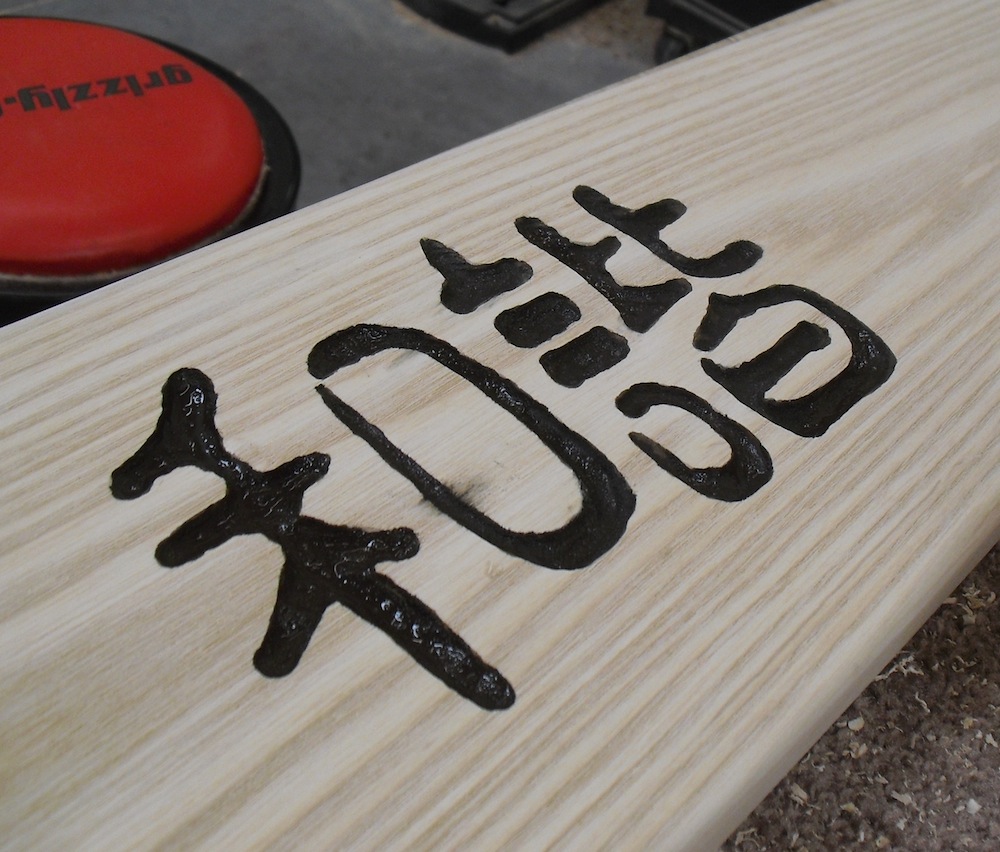
It's easy enough to paint the carving, and if you get a little sloppy, it really doesn't matter - you'll just sand it away after the Milkpaint dries. That little smudge on the second character will come right off when I sand.

While the Milkpaint was drying, I opened the package of bed rail hangers I had on hand.


I usually keep a few sets in my hardware stash; these have been in my shop for a long time - maybe eight years. Unfortunately, when I opened up the set of the ones I wanted to use - the 4" set of hangers, I discovered that two of the parts were missing.


@#$%&!!

I have a set of 6" hangers, but after laying one down on the bed, I know it's not going to work - it's just too big for this application.


I don't think I'd have much luck calling Rockler and telling them I'm missing part of my order from 2003, so I suck it up and order a couple of new sets, one for this piece, and one to keep in stock. I absolutely hate delays like this. This three day bed is turning into a longer project.

Note to self - next time, check your hardware when it arrives!

With the MilkPaint dried and the painted area sanded (to remove my sloppiness) - I gave the bed two coats of a handmade oil that I've started mixing myself.

It's a simple recipe - one part boiled linseed oil, one part varnish, and one part turpentine. Except for the bad smell from the turp, which disappears when it dries, I really like the way this stuff works. I love the protection it provides, and the finish it leaves on the wood is gorgeous. Here is the bed with two coats, which really makes the painted area POP.


Last step - making the side rails and installing the hardware. If I didn't run into this missing hardware issue, this bed would have been completed by now. It's always something.


Monday, August 01, 2011

Making a bed in three days

Damn, sometimes my ADHD just steps in the way of my normally scheduled work. Oh, I've never formally been diagnosed with it, but since the symptoms of ADHD include hyperactivity and impulsive behavior, I think I'm right in that ballpark. At least it's constructive impulsivity!

I am right in the middle of building six different pieces for clients and WHAM! - I had the urge to build a bed. I went to sleep with it on my mind the night before, and when I woke up, I couldn't stop thinking about it. If you've even been plagued with a focus like that, then you'll totally understand what I mean. It's consuming.

It's not a bad thing, though. I get a lot of stuff accomplished that way.

I went to the shop the next morning and cut a sample for the bed post leg that I'd been thinking about. It's a five-sided leg, similar to the one I'm making for the dining room table I'm building, too. Craig Vandall Stevens came up with this design, which is featured in the book - Creating Coffee Tables: An Artistic Approach.

It is one of my favorite books, and has inspired me numerous times. Here's the leg sample


I chose some nice boards of Ash that I had in my lumber stash,

and laminated for the bedposts.

Of course, they're bookmatched, so the grain is amazing.


Set the blade to 45˚


and let's start cutting.


Now it's time to trim them to length


and rout a nice curve into the legs.


Using set-up blocks, I lay out the mortise that I'll be cutting.


And set the depth stop on the mortiser, so I don't drill them too deep. In this case, I want them to be about 2/3s of the way through the post, so that I can pin the pieces together, using small dowels. Pinning the mortise-and-tenon joint makes it much stronger.


The cutting of the mortises is simple, I'm using a 3/4" bit here. Who knew you could drill a square hole?!


Once the lower mortises were cut, I used the set-up blocks again to locate the top headboard piece. The mattress I'll be using is about 8" tell, so those 1-2-3 blocks represent where the mattress will be sitting. The upper part of the post is where you'll see above the mattress, and that's where I'll be locating the headboard piece - where a pillow can be placed when someone wants to sit upright in bed.


After those upper mortises were cut, I needed to work on the head and footbaord crosspieces, cutting the tenons into them. There are a lot of ways to cut the tenons - I could have used a router with a straight bit in it, which is probably the most common method. But instead, I chose to use a radial arm saw with a stop block on the fence, to ensure that the length of each tenon was exactly the same. I was too lazy to put a dado blade in it, so the flat side of each tenon took a couple of minutes to cut.

People always ask me about dado blades - do I have them do I use them, blah, blah, blah. There is this love affair with them, probably from seeing them on too many woodworking TV shows or podcasts. My feeling about dados, and dado blades is this - if you have a tool that you can dedicate to a dado blade - so that you can leave it in that tool all the time, they're great. But - for me - switching back and forth from a dado to a regular sawblade is a PITA.

See, a regular sawblade removes wood 1/8 of an inch a time. But a dado blade can remove much more than that. So if you needed a 3/4" groove in a board, once pass over a dado blade would cut that groove. So would six passes over a 1/8" blade. Get it?

So in the time it takes to take the regular blade out, install the dado blade, and then cut the wider groove, I can simply make the six passes over the skinnier blade. It's a wash, in my opinion, so unless I have a butt-load of dados that I need to cut, I simply use my regular blade for most dado cuts.

The funny thing is - I have a killer Freud 10" dado blade set that I could install in my big radial arm saw. Maybe I'll do that one of these days, when I have time, just to be able to say - yes, I do have a dado set-up all ready to go. So what?

Here is a little diagram to show you what I'm trying to cut in each leg.


Anyway, once the tenon cheeks were cut, it was time to cut the vertical shoulders on each horizontal piece. I start by scoring the line with a chisel,


and then use a very thin kerf saw

to cut the tenon area away.


With that shoulder cut at the proper depth, a simple tap of the chisel allows that piece of wood to snap away.


Like this. It's quite simple, it barely takes a light top of the chisel for it to pop off.


So far, I'm a day and a half into this project, and there are really only a few operations left - but very important ones. The vision I have for this bed is a very simple one - understated, with a zen quality to it. Years ago, I'd made a bed similar to this, and it sold immediately. I've been thinking of making another one ever since. I kept seeing a carving on the headboard in my mind - do other artists do that? Do they "see" things in their head, and then transfer them into physical pieces?

I play on the computer until I get the artwork sized correctly for the carving I want to use. This is a common method for me when carving - playing with fonts and sizes until I come up with something that suits the piece.


Here, this kanji symbol means "peace and harmony" - a fitting inscription for a headboard, I think. It's attached to the headboard with a glue stick,


and carved in place. I'm by no means any expert at carving, but I get by with a few chisels and some touch-up with a Dremel.


Sand the paper off, and here is what you get.


It's time to dry-fit everything together, to make sure all the joints fit well and everything will go together smoothly when I glue this piece together.


With all the joinery cut and the carving completed, it's time for some serious sanding on each component. There won't be a chance to sand in the nooks and crevices of this piece, once it is assembled, so I hook up the Festool sanders and go to work. Everything is sanded, to 180 grit, which is pretty fine. Then - it's a simple matter of gluing up the headboard and footboard. This is a queen bed, so it's about 60" wide. Since I only have two long bar clamps in my shop (the rest are at home, of course!) - I end up walking next door to borrow a couple of long clamps from my buddy, Eddie, who runs a countertop shop.

By now, it's the end of the second day, and the bed is nearly done. I'll clamp it up overnight, and work on the side rails in the morning.