There is nothing like an old fashioned cold to stop me in my tracks. I've been sick for about a week, and it's wiping me out, energy wise. Yes, I've been taking everyone's advice - rest, liquids, chicken soup - nothing is helping.
Until I get back into the woodshop, there isn't much to blog about. But I saw these videos and thought they were pretty great. .... enjoy!
Monday, February 21, 2011


Tuesday, February 15, 2011
One-of-a-kind walking stick
This is one of those times when blogging gets in the way of woodworking! When that happens, you (meaning - me!) have to make a decision about your priority.
So here is my confession - it's all about the wood. That has to be my priority.
Remember in my last post, I was hired to turn this fighter jet control stick into a walking stick for a pilot who was retiring. A few different people who inspected this piece speculated that it was either from an F-4 jet or an F-15.

Whatever. Let's make the stick.
The pilot who is receiving this retirement gift is tall, maybe 6'3" or more, so I grabbed a few of my height-endowed buddies and had them hold the handle in a comfortable position, as if they were hiking. That gave me the rough length of this stick. It also told me that my drill press didn't have enough capacity for me to cut a tenon on the end of the piece of wood. I was just short a couple of inches, so I lifted the drill press up on the step next to it, and swiveled the head around. I also had to tilt the table 90˚ so that I could clamp the piece of wood to it.

There is more than one way to skin that proverbial cat.
Then - things got dicey. I had a class starting in an hour so, and I wanted to finish up on most of the work on this. So I forgot to take pictures along the way. Sorry.
Here is the tenon formed on the end of the wood.

Next stop? Tapering.
I'll try to describe it - but it might make more sense if you scroll down to the bottom to see the finished picture of this piece. Notice how the wood tapers from about two inches at the top, to about 3/4s of an inch at the bottom? Cutting a taper like that using a taper jig with the tablesaw would have been nearly impossible.
The next best tool for tapering is the jointer, which is where I headed. Once you've tapered on the jointer, it's uber-easy. But here's a video that more or less shows how I cut them. I cut my tapers a little differently than this fellow cuts his - more conservatively, by taking many small passes over the blade, rather than the two big bites that he took. Also, He cuts his taper at the end of this piece of wood, and I start mine the nose of the piece of wood. Again - ask ten woodworkers how to do something and you'll get eleven answers. Whatever - as long as you accomplish the same end result, it really doesn't matter if everyone is safe while they're doing what they're doing.
Once the wood was tapered, I rounded over all the edges with various round-over bits on my router, so that the stick was perfectly circular. I started with a 3/4" bit, and then as the piece of wood tapered to a smaller dimension, I switched to a 1/2" bit, and then at the end, to a 3/8" bit. Again, being rushed for time didn't allow me to photograph any of this. But - it's a very easy way to make a long stick of wood appear as if it was turned on the lathe.
Yup, a easier way would have been to simply buy a wooden dowel and use that, but it wouldn't have had the same, graceful tapered appearance.

I considered putting a small metal cap at the end of the stick, to protect it from splitting in case it was actually used as a walking stick.
Since the metal on the flight stick was silver toned, I wanted to use a material that would look similar. A stainless steel cap was a perfect solution.

But - after putting a sample cap on the end, I decided I didn't really like the look of it. So I left it off. That's called artistic license, and I use mine liberally.

Next step was to apply some finish to the stick and mount the handle. I applied a couple of different finishes - first a coat of Watco Danish Oil, to bring out the color of the walnut. Then - after it dried for a few days, I applied a few coats of a handrubbed varnish, for extra protection. Using the combination of these two finishes gives you the best of both worlds - the great color that comes from using oil, and the protection that varnish provides. Sweet.

Finally, a coat of paste wax was applied. I masked off the tenon while I was applying the wax, as I didn't want to get it on the area where I would be applying epoxy.
 Some five minute epoxy and a screw through one of those holes, and that handle will never come off!

Just as I was taking these last two photos, my client came in to pick up the piece.

Congrats to the pilot who received this walking stick, thanks for your many years of service. I love making unique pieces like this - enjoy your retirement!

So here is my confession - it's all about the wood. That has to be my priority.
Remember in my last post, I was hired to turn this fighter jet control stick into a walking stick for a pilot who was retiring. A few different people who inspected this piece speculated that it was either from an F-4 jet or an F-15.

Whatever. Let's make the stick.
The pilot who is receiving this retirement gift is tall, maybe 6'3" or more, so I grabbed a few of my height-endowed buddies and had them hold the handle in a comfortable position, as if they were hiking. That gave me the rough length of this stick. It also told me that my drill press didn't have enough capacity for me to cut a tenon on the end of the piece of wood. I was just short a couple of inches, so I lifted the drill press up on the step next to it, and swiveled the head around. I also had to tilt the table 90˚ so that I could clamp the piece of wood to it.

There is more than one way to skin that proverbial cat.
Then - things got dicey. I had a class starting in an hour so, and I wanted to finish up on most of the work on this. So I forgot to take pictures along the way. Sorry.
Here is the tenon formed on the end of the wood.
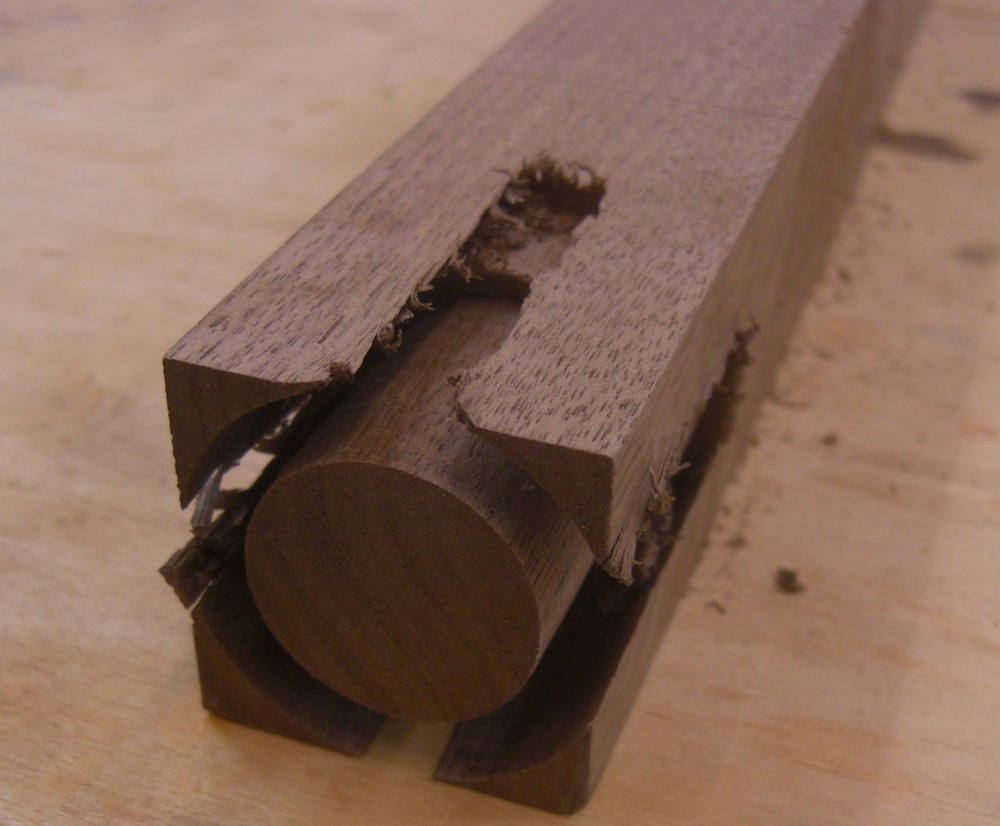
Next stop? Tapering.
I'll try to describe it - but it might make more sense if you scroll down to the bottom to see the finished picture of this piece. Notice how the wood tapers from about two inches at the top, to about 3/4s of an inch at the bottom? Cutting a taper like that using a taper jig with the tablesaw would have been nearly impossible.
The next best tool for tapering is the jointer, which is where I headed. Once you've tapered on the jointer, it's uber-easy. But here's a video that more or less shows how I cut them. I cut my tapers a little differently than this fellow cuts his - more conservatively, by taking many small passes over the blade, rather than the two big bites that he took. Also, He cuts his taper at the end of this piece of wood, and I start mine the nose of the piece of wood. Again - ask ten woodworkers how to do something and you'll get eleven answers. Whatever - as long as you accomplish the same end result, it really doesn't matter if everyone is safe while they're doing what they're doing.
Once the wood was tapered, I rounded over all the edges with various round-over bits on my router, so that the stick was perfectly circular. I started with a 3/4" bit, and then as the piece of wood tapered to a smaller dimension, I switched to a 1/2" bit, and then at the end, to a 3/8" bit. Again, being rushed for time didn't allow me to photograph any of this. But - it's a very easy way to make a long stick of wood appear as if it was turned on the lathe.
Yup, a easier way would have been to simply buy a wooden dowel and use that, but it wouldn't have had the same, graceful tapered appearance.

I considered putting a small metal cap at the end of the stick, to protect it from splitting in case it was actually used as a walking stick.
Since the metal on the flight stick was silver toned, I wanted to use a material that would look similar. A stainless steel cap was a perfect solution.

But - after putting a sample cap on the end, I decided I didn't really like the look of it. So I left it off. That's called artistic license, and I use mine liberally.

Next step was to apply some finish to the stick and mount the handle. I applied a couple of different finishes - first a coat of Watco Danish Oil, to bring out the color of the walnut. Then - after it dried for a few days, I applied a few coats of a handrubbed varnish, for extra protection. Using the combination of these two finishes gives you the best of both worlds - the great color that comes from using oil, and the protection that varnish provides. Sweet.

Finally, a coat of paste wax was applied. I masked off the tenon while I was applying the wax, as I didn't want to get it on the area where I would be applying epoxy.
 Some five minute epoxy and a screw through one of those holes, and that handle will never come off!
Just as I was taking these last two photos, my client came in to pick up the piece.

Congrats to the pilot who received this walking stick, thanks for your many years of service. I love making unique pieces like this - enjoy your retirement!

Tuesday, February 08, 2011
Plant a tree this spring
Last night, one of the largest group of students I've worked with gathered in my studio to begin their woodworking journey. That might sound hokey, but that is the truth, and their enthusiasm was contagious. We went through a amazing amount of information, and later, they finally got some one-on-one time with wood and glue.
Does it get any better?
When I got home at the end of the night, I was running over the class in my head, thinking about how much material we used and that I'd need to prep more wood for the new class starting in just two days.
Wood, wood, wood... our lumber industry seems so antiseptic and tidy - you go to the lumberyard and pick out a board. If you're lucky, it's straightlined, relatively flat, and ready to use. But wood has changed so much over the years, do people even realize that?
Not to get all "old timer" on you, but when I was in high school, the lumber was had available was amazing - mahogany boards that were often 15" wide, with stunning color and grain figure.

Now? Narrower boards with dull color.
Think about it - how long does it take to grow a tree large enough to produce boards to use for furniture making? Are the lumber companies replacing what they cut, or is sustainability just not possible? When you read in the news about logging and deforestation, are you outraged, or do you just want that nice new bedroom set, regardless of the impact on the environment?
I've been trying to lessen the impact of the woodworking classes I teach on the environment - from the materials we use, to the finishes we apply. Students are encouraged to donate items to the shop - everything from old rags for applying finishes to carpet scraps to protect our work while sanding. Many have been much more generous - donating tools and time and woods that they no longer need. It all helps, and lessens our dependency on purchasing these items.
All of this is on my mind because I recently saw this video. The footage is stunning, showing one of the last uncontacted tribes living in Brazil, unaware of the rest of the world. But that could be about to change, with lumber companies moving in, hoping to get their hands on all that virgin timber. In this day and age of iPods, cell phones and Facebook, how is it even possible that tribes like this still exist? Amazing.
What will become of them? Is it possible that the tribe and their land will be protected, or will some large lumber conglomerate move in and take what they want? Who will step up and protect them?

What can you do? That's a good question, and I don't have an answer for it. But I do know this - we have to start replenishing this planet if we care at all about its survival. Use less plastic products. Buy less junk. Recycle. Plant a tree this spring, when you're putting your garden in the ground. Get together with your neighbors and clean up your block.

And if you're a woodworker, consider the impact of your work on the environment. Can you find a use for your sawdust? Do your wood scraps end up in the trash, or could a neighbor use them? I know that I've started donating scrap to various places around town - everything from kindling for woodstoves to sending boxes of interesting wood cut-offs to other artists for use in their work.
It's a start.
Does it get any better?
When I got home at the end of the night, I was running over the class in my head, thinking about how much material we used and that I'd need to prep more wood for the new class starting in just two days.
Wood, wood, wood... our lumber industry seems so antiseptic and tidy - you go to the lumberyard and pick out a board. If you're lucky, it's straightlined, relatively flat, and ready to use. But wood has changed so much over the years, do people even realize that?
Not to get all "old timer" on you, but when I was in high school, the lumber was had available was amazing - mahogany boards that were often 15" wide, with stunning color and grain figure.

Now? Narrower boards with dull color.
Think about it - how long does it take to grow a tree large enough to produce boards to use for furniture making? Are the lumber companies replacing what they cut, or is sustainability just not possible? When you read in the news about logging and deforestation, are you outraged, or do you just want that nice new bedroom set, regardless of the impact on the environment?
I've been trying to lessen the impact of the woodworking classes I teach on the environment - from the materials we use, to the finishes we apply. Students are encouraged to donate items to the shop - everything from old rags for applying finishes to carpet scraps to protect our work while sanding. Many have been much more generous - donating tools and time and woods that they no longer need. It all helps, and lessens our dependency on purchasing these items.
All of this is on my mind because I recently saw this video. The footage is stunning, showing one of the last uncontacted tribes living in Brazil, unaware of the rest of the world. But that could be about to change, with lumber companies moving in, hoping to get their hands on all that virgin timber. In this day and age of iPods, cell phones and Facebook, how is it even possible that tribes like this still exist? Amazing.
What will become of them? Is it possible that the tribe and their land will be protected, or will some large lumber conglomerate move in and take what they want? Who will step up and protect them?

What can you do? That's a good question, and I don't have an answer for it. But I do know this - we have to start replenishing this planet if we care at all about its survival. Use less plastic products. Buy less junk. Recycle. Plant a tree this spring, when you're putting your garden in the ground. Get together with your neighbors and clean up your block.

And if you're a woodworker, consider the impact of your work on the environment. Can you find a use for your sawdust? Do your wood scraps end up in the trash, or could a neighbor use them? I know that I've started donating scrap to various places around town - everything from kindling for woodstoves to sending boxes of interesting wood cut-offs to other artists for use in their work.
It's a start.
Tuesday, February 01, 2011
Rubbing the block on...
Oh don't get all pervy, rub blocks are one of the last steps for finishing the table in my shop. The leaves and top are getting their final coats of rubbed on poly,
 and next, I'll climb underneath and apply some rub blocks to the new table extension slide. They're not totally necessary, but better quality tables use rub blocks to reinforce the slides.
So... you know I'm all about that.
Make some quarter-round molding, and cut it into 3" lengths.
 Then coat the edges in glue, and rub them into place, against the slide.
 Make sure you apply them on the side that stays in place, not the one that needs to move!
This has been a week of finishing up some older orders around the shop, and getting prepared for UNLV classes starting here next week. Cleaning, organizing, getting the clamps back into some semblance of order, even though that won't last. A big thanks to my buddy, Danny, who welded a new rack on top of the clamp cart, for my baby clamps.

I even hung a new self portrait in the office.

Things are getting pretty orderly, there are various projects stashed all over the shop, like Coach's set of dressers for his grandson Noah.

A little zen area of the shop - one of the Peace tumblers, and the all important carry-out menus. Nothing like picking up a steaming bowl of pho on the way home.

Finally, on to my next project. I get some of the coolest orders in town, and this is another one of them. Someone brought by a fighter jet flight stick and asked if I could turn it into a walking stick for a retiring pilot.

It's a little grubby, and needs some TLC, but entirely awesome to hold in your hand. The ergonomics of it are amazing.

I'm sure those buttons do things I don't even want to think about.
So for now, I'll just concentrate on making the walking stick and think about the fellow who is retiring, thanking him for his years of service.

 and next, I'll climb underneath and apply some rub blocks to the new table extension slide. They're not totally necessary, but better quality tables use rub blocks to reinforce the slides.
So... you know I'm all about that.
Make some quarter-round molding, and cut it into 3" lengths.
 Then coat the edges in glue, and rub them into place, against the slide.
 Make sure you apply them on the side that stays in place, not the one that needs to move!
This has been a week of finishing up some older orders around the shop, and getting prepared for UNLV classes starting here next week. Cleaning, organizing, getting the clamps back into some semblance of order, even though that won't last. A big thanks to my buddy, Danny, who welded a new rack on top of the clamp cart, for my baby clamps.

I even hung a new self portrait in the office.

Things are getting pretty orderly, there are various projects stashed all over the shop, like Coach's set of dressers for his grandson Noah.

A little zen area of the shop - one of the Peace tumblers, and the all important carry-out menus. Nothing like picking up a steaming bowl of pho on the way home.

Finally, on to my next project. I get some of the coolest orders in town, and this is another one of them. Someone brought by a fighter jet flight stick and asked if I could turn it into a walking stick for a retiring pilot.

It's a little grubby, and needs some TLC, but entirely awesome to hold in your hand. The ergonomics of it are amazing.

I'm sure those buttons do things I don't even want to think about.
So for now, I'll just concentrate on making the walking stick and think about the fellow who is retiring, thanking him for his years of service.

Sunday, January 30, 2011
Leaves of time.....
Back in December, I was doing some repair work to an old dining room table when I had a small accident. The finger is better (still pretty ugly, though!) and the table is finally close to being finished. With repair work, you never know what you're getting into - sometimes you'll find parts that you didn't realize were broken, or joints that need disassembled and completely rebuilt. Even worse, sometimes the wooden pieces are too warped or cracked to use again, so new pieces have to be built from scratch. Finally, getting it all to match is difficult - in short, that's why I don't take on a lot of repair work!
Here is the table with it's new top, awaiting some final coats of polyurethane.

Poly isn't my finish of choice, but for tables, it's really the best protection. I added some extension slides so that the table will hold three new leaves that I also made.

Wooden extensions like this are quirky - prone to humidity fluctuations, so I had to wait until the weather calmed down a bit. We had a rainy spell a few weeks ago, and if I had installed these then, they would have absorbed some ambient moisture and probably been difficult to open. Another thing about these slides - the manufacturer lubes them up with a greasy substance to keep them traveling smoothly. That makes them messy to handle, and if you get the lube on your hands and transfer it onto the raw wood, the finish will not absorb correctly. So the slides are one of the last parts to be attached to the table.
Here is one of the leaves, ready for drilling.

I put four wooden pins on each leaf, to align them,

and used a doweling jig to drill the holes perfectly plumb.

A simple wooden height gauge cut on the table saw ensures that all the pins are set at the same height.

Nothing glamorous going on in the woodshop, just a whole lot o' drilling.

If you know me, you know I barely use a tape measure in my shop for most tasks. Here, a series of 1-2-3 set-up blocks helps me space the holes the perfect distance from the end of each leaf.
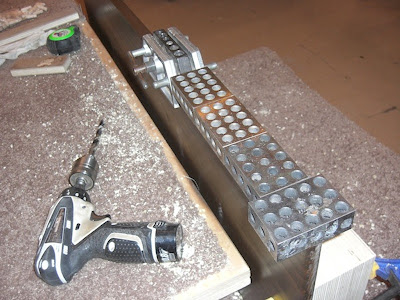
Ready for some final tinting and poly coats.

A test fit in the table, and a big sigh of relief that this job is nearly complete!

I've been taking film classes and working on my video production skills - gotta love being a Mac user and using iMovie. Here's a little video on drilling all the leaf pin holes. (As usual, I work better to loud and fast music, so if that bothers you, turn the volume down.) The video is mostly for wood geeks, but have a look.
Here is the table with it's new top, awaiting some final coats of polyurethane.

Poly isn't my finish of choice, but for tables, it's really the best protection. I added some extension slides so that the table will hold three new leaves that I also made.

Wooden extensions like this are quirky - prone to humidity fluctuations, so I had to wait until the weather calmed down a bit. We had a rainy spell a few weeks ago, and if I had installed these then, they would have absorbed some ambient moisture and probably been difficult to open. Another thing about these slides - the manufacturer lubes them up with a greasy substance to keep them traveling smoothly. That makes them messy to handle, and if you get the lube on your hands and transfer it onto the raw wood, the finish will not absorb correctly. So the slides are one of the last parts to be attached to the table.
Here is one of the leaves, ready for drilling.

I put four wooden pins on each leaf, to align them,

and used a doweling jig to drill the holes perfectly plumb.

A simple wooden height gauge cut on the table saw ensures that all the pins are set at the same height.

Nothing glamorous going on in the woodshop, just a whole lot o' drilling.

If you know me, you know I barely use a tape measure in my shop for most tasks. Here, a series of 1-2-3 set-up blocks helps me space the holes the perfect distance from the end of each leaf.

Ready for some final tinting and poly coats.

A test fit in the table, and a big sigh of relief that this job is nearly complete!

I've been taking film classes and working on my video production skills - gotta love being a Mac user and using iMovie. Here's a little video on drilling all the leaf pin holes. (As usual, I work better to loud and fast music, so if that bothers you, turn the volume down.) The video is mostly for wood geeks, but have a look.
Friday, January 28, 2011
Musical aptitude
It's probably best that I don't have a piano in my house, or Stella would likely try this.
Thursday, January 20, 2011
Fun with chisels
Sometimes watching how something is built is much easier than having it explained to you. Here's a lovely, folding bookstand, somewhat complicated to build. Check out this nicely produced video to see how it's made.
Saturday, January 15, 2011
Changing planer blades (again!)
It's about to get a little crazy in the shop, with lots of classes starting and projects being completed. So I thought it best to do a little maintenance around the place. Sending blades to be sharpened is the first place I start.

You know you basically have no life when the highlight of your week is having your three favorite sawblades sharpened and ready to re-install.

Sharp jointer and planer blade are icing on the cake.

I've gotten pretty quick at installing the planer blades.

Keeping the manual and knife press gauge handy helps!
 This diagram tells me just about everything I need to know about installing the blades at the correct height.
 And all I need to do this blade replacement are two very important things - a cup of coffee and a wrench. The coffee isn't essential, but really helps.

Install the springs that go under the blade,
 slide in the gib, that holds the blade in place,

and slide the blade into place. Remember, it's very sharp. Then put the height gauge over the blade and press down.... GENTLY!
 You don't want to ding your blade, do you?

Here is a short video to show you how simple it is.
Time for another cup o' joe.... good luck replacing your blades!

You know you basically have no life when the highlight of your week is having your three favorite sawblades sharpened and ready to re-install.

Sharp jointer and planer blade are icing on the cake.

I've gotten pretty quick at installing the planer blades.

Keeping the manual and knife press gauge handy helps!
 This diagram tells me just about everything I need to know about installing the blades at the correct height.
 And all I need to do this blade replacement are two very important things - a cup of coffee and a wrench. The coffee isn't essential, but really helps.
Install the springs that go under the blade,
 slide in the gib, that holds the blade in place,
and slide the blade into place. Remember, it's very sharp. Then put the height gauge over the blade and press down.... GENTLY!
 You don't want to ding your blade, do you?
Here is a short video to show you how simple it is.
Time for another cup o' joe.... good luck replacing your blades!
Tuesday, January 04, 2011
Snow in the New Year
It snowed here in Vegas this week, not necessarily a good way to start the year, in my opinion. Everyone has a picture of snow in their yard, or wherever they happened to be when it was coming down. Here are my two obligatory shots - from the back yard - my raised bed garden, which sure looks different with a layer of white on it.

And the grill, which of course, didn't have it's cover on. I think it blew away in the windstorm, and is probably laying in someone's yard down the street. The wind here was brutal.

The next morning, I was stuck in a snowstorm on the freeway, on my way to jury duty. Everyone was driving like they'd never seen snow in their lives, and probably hadn't. The traffic was cluster-fucking-unbelievable; I was late to the courthouse, which didn't make a good impression on my new buddy, the courthouse clerk.
Stella, on the other hand, had a marvelous time in the snow. She played for a few hours, and I just couldn't find it in my heart to make her come inside. I mean, how often will she ever get the chance to play in snow? Here she is, in all her messy, muddy glory. You can bet she went straight into the bathtub after we took this photo.
 Finally, later in the evenings, long after my woodworking duties are done, I've been playing with clay again. Here are a few new layered glaze experiments. I'm quite pleased with what has been coming out of the kiln, now that is a good way to start the year!


And the grill, which of course, didn't have it's cover on. I think it blew away in the windstorm, and is probably laying in someone's yard down the street. The wind here was brutal.

The next morning, I was stuck in a snowstorm on the freeway, on my way to jury duty. Everyone was driving like they'd never seen snow in their lives, and probably hadn't. The traffic was cluster-fucking-unbelievable; I was late to the courthouse, which didn't make a good impression on my new buddy, the courthouse clerk.
Stella, on the other hand, had a marvelous time in the snow. She played for a few hours, and I just couldn't find it in my heart to make her come inside. I mean, how often will she ever get the chance to play in snow? Here she is, in all her messy, muddy glory. You can bet she went straight into the bathtub after we took this photo.
 Finally, later in the evenings, long after my woodworking duties are done, I've been playing with clay again. Here are a few new layered glaze experiments. I'm quite pleased with what has been coming out of the kiln, now that is a good way to start the year!


Subscribe to:
Posts (Atom)